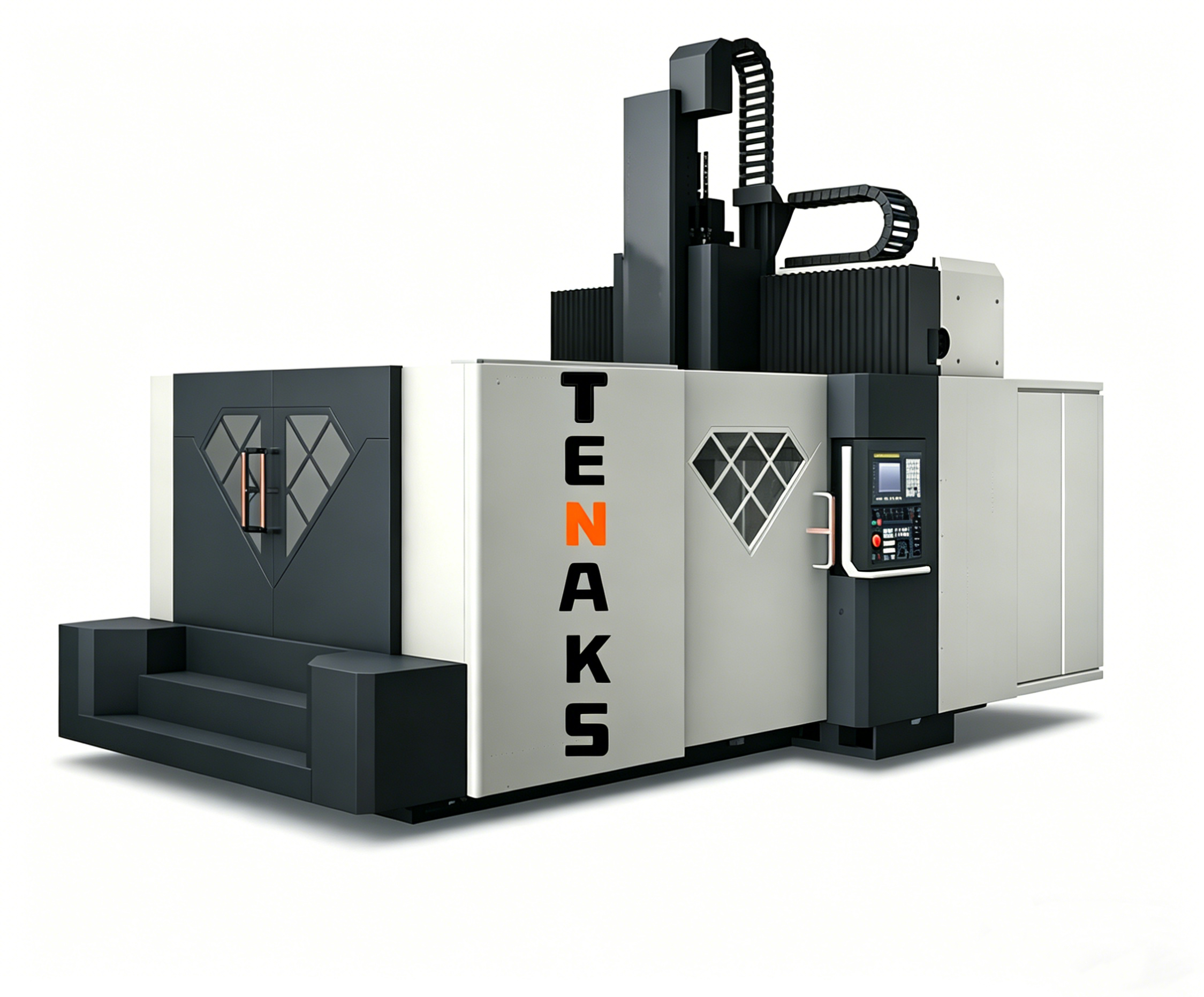
In the field of machining, gantry machining centres are highly regarded for their powerful machining capabilities. The fixed-beam, moving-table and moving-beam, moving-column types are the two most common variants. Each has its own characteristics and is suited to different machining requirements; below, we provide a comparative analysis of the two from multiple perspectives.
I. Differences in structural design
(1) Fixed-beam moving-table type
In a fixed-beam, moving-table gantry machining centre, the gantry frame—comprising the crossbeam and columns—remains stationary, serving as a solid "wall" that provides a stable foundation for the machining process. The worktable moves along the bed’s guideways to achieve movement in the X-axis direction. The cutting tool is mounted on a ram attached to the fixed crossbeam; through the vertical movement of the ram (Z-axis direction) and the lateral movement on the crossbeam (Y-axis direction), it coordinates with the movement of the worktable to complete the machining operation. This structural design ensures high overall rigidity for the machine tool, enabling it to effectively withstand the cutting forces and vibrations generated during machining.
(2) Moving-beam, moving-column type
A key feature of moving-beam, moving-column gantry machining centres is that the crossbeam and columns can move along the bed’s guideways in the X-axis direction, whilst the crossbeam itself can move up and down in the Z-axis direction; the worktable, meanwhile, remains stationary or moves within a limited range. This configuration offers a high degree of flexibility, allowing the position and height of the gantry frame to be adjusted according to machining requirements to accommodate workpieces of varying sizes and shapes.
II. Comparison of Performance
(1) Rigidity and stability
Fixed-beam, moving-table gantry machining centres offer outstanding stability during machining due to their fixed gantry frame. Particularly during heavy-duty cutting operations, they maintain a high level of rigidity, minimizing the impact of vibration and deformation on machining accuracy, making them suitable for the machining of large components with stringent precision requirements. Although moving-beam, moving-column gantry machining centres offer a degree of structural flexibility, their overall rigidity and stability are slightly inferior to those of fixed-beam, moving-table models during heavy-duty cutting operations due to the movement of the crossbeam and columns. However, through optimised design and structural reinforcement, they can still meet the rigidity requirements for most routine machining tasks.
(2) Machining accuracy
Fixed-beam, moving-table gantry machining centres, with their stable structure combined with high-precision guideways, drive systems and optional closed-loop measurement using linear encoders, are capable of achieving very high machining accuracy. They are particularly suitable for machining applications with stringent accuracy requirements, such as precision moulds and aerospace components. Although moving-beam, moving-column gantry machining centres also perform well in terms of precision, their numerous moving components make precision control relatively complex; consequently, they are slightly inferior to fixed-beam, moving-table models in the field of ultra-precision machining.
(3) Processing efficiency
Due to the movement of the gantry frame, moving-beam, moving-column gantry machining centres offer greater convenience when adjusting machining positions. For workpieces that require frequent changes in machining position, this reduces auxiliary processing time and improves machining efficiency. Furthermore, their flexible structure allows them to adapt quickly to the machining of workpieces of different sizes without the need for extensive adjustments to the tooling and fixtures. Meanwhile, fixed-beam, moving-table gantry machining centres can also achieve high production efficiency when batch-processing workpieces of the same type, thanks to the rapid movement of the worktable and stable machining performance.
III. Differences in applicable scenarios
(1) Fixed-beam, moving-table type
Suitable for high-precision machining of large, heavy workpieces, such as automotive engine blocks, generator stators and large ship propellers. In the aerospace sector, fixed-beam, moving-table gantry machining centres can also leverage their high precision and rigidity to ensure machining quality when processing high-precision components such as aircraft fuselage structural parts and aeroengine blades.
(2) Moving-beam, moving-column type
It is particularly well-suited to machining workpieces with complex shapes and significant variations in dimensions. In the mould manufacturing industry, where moulds of varying specifications and shapes are processed, moving-beam, moving-column gantry machining centres can flexibly adjust machining positions and heights, thereby enhancing adaptability. In enterprises engaged in single-unit or small-batch production, where machining requirements are diverse, the flexibility of moving-beam, moving-column gantry machining centres is better able to meet production demands. Both fixed-beam, moving-table and moving-beam, moving-column gantry machining centres have their own advantages. If you would like to learn more about the specifics of either type, or if you have any requirements regarding equipment selection, please do not hesitate to contact me.