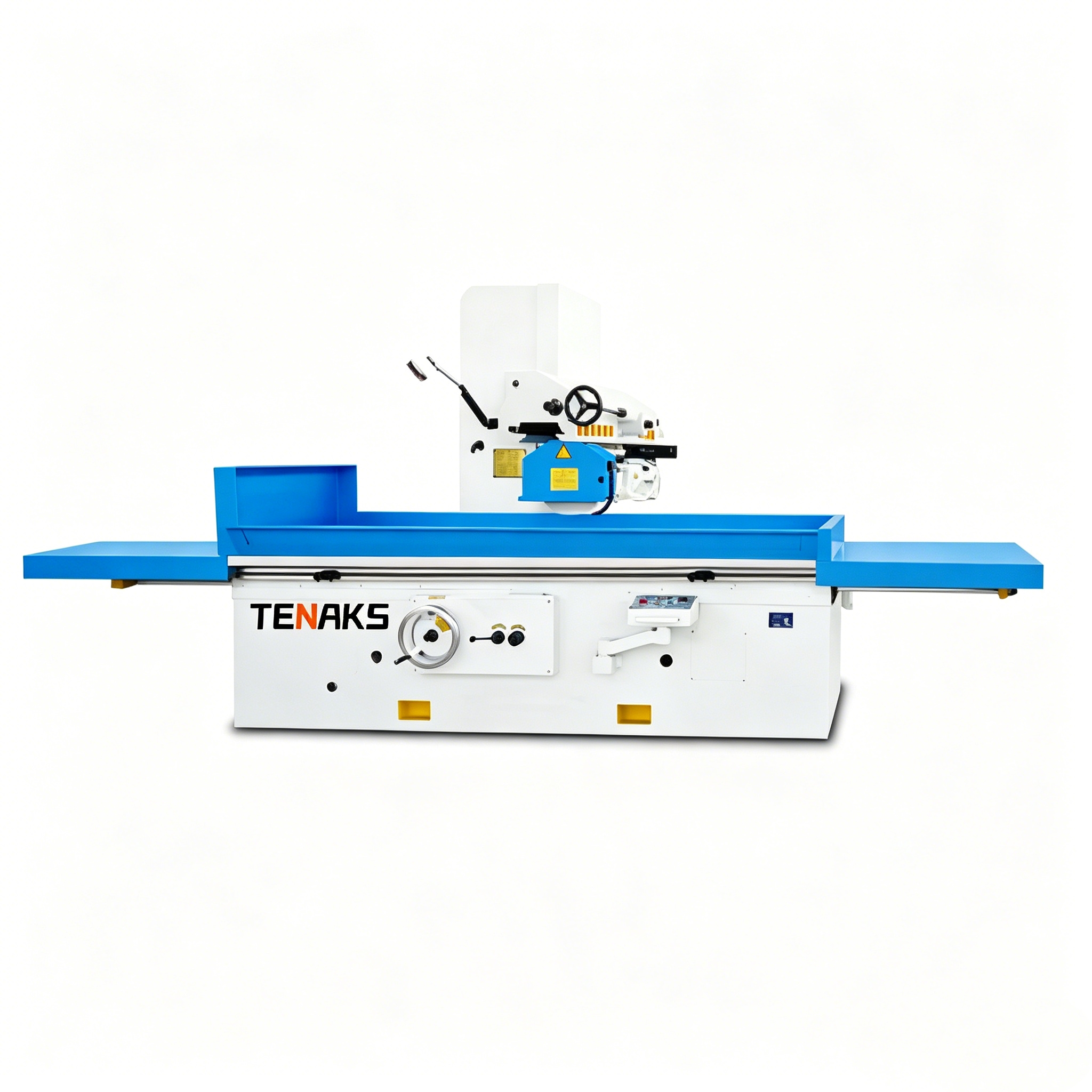
Development Trends of Precision Surface Grinders
Against the backdrop of continuous manufacturing upgrading and rapid technological innovation, precision surface grinders, as key equipment in precision machining, have attracted extensive attention for their future development trends. The following is an in-depth analysis of their development directions from multiple dimensions.
I. Intelligent Upgrading
Intelligence is one of the core trends in the future development of precision surface grinders. With the deep integration of cutting-edge technologies such as the Internet of Things, big data, and artificial intelligence, precision surface grinders will be equipped with more powerful intelligent functions. Through real-time collection of equipment operation data via sensors and in-depth mining of data value using big data analysis technology, accurate monitoring of equipment status and early fault warning can be realized.
For example, the intelligent system can intelligently adjust grinding parameters based on data such as vibration and temperature generated during the grinding process, ensuring the processing is always in optimal condition and significantly improving machining accuracy and efficiency. In addition, with remote control technology, operators can control and monitor the grinder from a remote location, greatly improving equipment management efficiency and reducing maintenance costs.
II. Advancement to Higher Precision
With the increasing demand for product precision in various industries, the development of higher precision for precision surface grinders is imperative. On the one hand, mechanical structure design is continuously optimized, and high-rigidity, high-precision materials are adopted to reduce errors in mechanical transmission and improve equipment stability. On the other hand, continuous innovation is made in grinding processes, such as developing more advanced grinding wheel materials and grinding fluids, and optimizing grinding path planning to further enhance machining accuracy.
In the semiconductor manufacturing industry, high flatness of silicon wafers is required, and future precision surface grinders need to achieve higher-precision surface grinding to meet industrial development needs. It is expected that in the next few years, the machining accuracy of precision surface grinders will advance from the current micron level to the sub-micron or even nanometer level.
III. Diversification of Functions
To meet diversified production demands, precision surface grinders will develop toward multi-functionality. In addition to the traditional surface grinding function, they will integrate various processing technologies such as curved surface grinding, drilling, and milling. Multiple processes can be completed in a single workpiece clamping, reducing workpiece transfer between different equipment, minimizing machining errors, and improving production efficiency.
In the mold manufacturing industry, molds feature complex structures requiring various processing operations. Multi-functional precision surface grinders can meet diverse mold processing requirements in one stop, improving the accuracy and efficiency of mold manufacturing.
IV. Green Transformation
With growing global environmental awareness, green development has become an inevitable trend for precision surface grinders. In the design stage, full consideration is given to energy consumption, and energy-saving drive and control systems are adopted to reduce energy consumption during operation. Meanwhile, the cooling system is optimized to cut down coolant usage and waste liquid discharge. Furthermore, recyclability and reusability of components are emphasized after equipment scrapping to realize resource recycling. For instance, the adoption of new dry grinding technology eliminates the use of coolant, reducing environmental pollution at the source.
V. Integration of Customization and Modularization
Production demands vary greatly among different customers. Future precision surface grinders will pay more attention to customized services. Through modular design, each functional unit of the grinder is standardized and encapsulated. Customers can select and combine different modules according to their own needs to quickly build a grinder that meets specific production requirements.This integration of customization and modularization not only improves equipment applicability but also shortens R&D and manufacturing cycles and reduces production costs.
VI. High-Speed Development
Increasing grinding speed is an important way to improve the processing efficiency of precision surface grinders. In the future, through the development of high-speed spindles, optimization of grinding wheel performance, and improvement of the dynamic balance design of the machine structure, precision surface grinders will achieve higher grinding speeds.
High-speed grinding can remove more materials per unit time, reduce thermal damage to the workpiece surface, and improve processing quality. In the aerospace industry, there is an urgent demand for efficient processing of difficult-to-machine materials such as titanium alloys, which can be effectively met by high-speed precision surface grinders.